
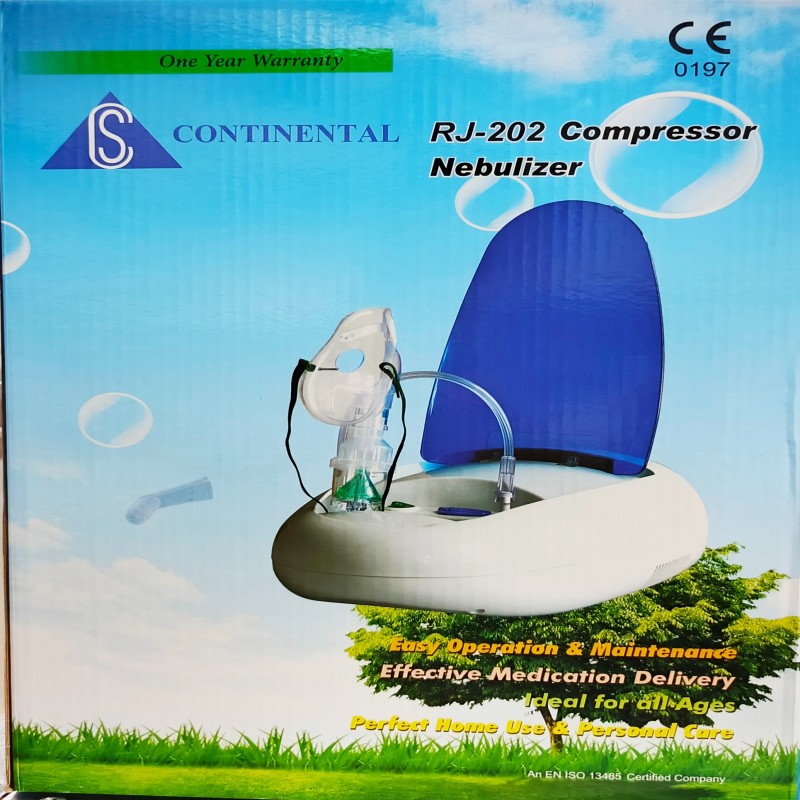
Specifications:
* Length: 19 cm (7")
* Height: 9 cm (4")
* Particle Size: (MMAD) < 5 µm
* Air Flow: 5.1 l/min
* Aerosol Output: 0.45 ml
* Aerosol Output Rate: 0.02 ml/min
* Power Supply: 230V, 50Hz
* Noise: 52 dbA
* Total Weight: 1.5 kg (3.3 lb)
* Import From China
Jet Nebulizers:
Mechanism: These use a compressor and compressed air to create a mist.
Pros: They are generally the most affordable and can be used with a wide range of medications, including suspensions.
Cons: They tend to be the bulkiest and noisiest option, making them less portable.
Ultrasonic Nebulizers:
Mechanism: High-frequency sound waves from a vibrating piezoelectric element are used to produce the mist.
Pros: They are quieter and faster than jet nebulizers.
Cons: They are generally more expensive and not suitable for all types of medications, particularly heat-sensitive ones or suspensions.
Mesh Nebulizers:
Mechanism: Liquid medication is pushed through a fine mesh with thousands of tiny holes to generate a very fine mist.
Pros: These are the newest and most efficient, offering fast treatment times, quiet operation, and high portability due to their small size and battery power.
Cons: They are typically the most expensive and require meticulous cleaning to prevent the mesh from clogging, especially with thicker medications.
Omron NE-C101 Compressor Nebulizer Machine:
This is a widely available and reliable compressor model.
TAKE A BREATH Portable Handheld Mesh Nebulizer:
The CPAP Shop's editors highlight this product's compact size and minimal design that allows for easy maintenance and cleaning.
It operates quietly (below 50 dBa) and offers quick treatment times due to its vibrating mesh technology.
DeVilbiss Traveller Portable Compressor Nebulizer System:
This system is noted for its versatility in power sources (AC outlet, car outlet, or rechargeable battery) and one-touch operation, making it excellent for travel.
According to thecpapshop.com, it is a great choice for patients of all ages due to its simple use.
Consult a doctor: Always use a nebulizer under the guidance of a healthcare professional to determine the appropriate machine type and medication.
Regular cleaning: Wash all parts (mask, mouthpiece, medication cup) with warm, soapy water after each use and rinse thoroughly to prevent contamination. The tubing and compressor unit should not be washed.
Replace parts: Nebulizer masks should be changed every six months, and the air filter replaced if dirt accumulates.

this good product
All Rights Reserved © Continental Surgicals